I'm no fan of Jonathan Franzen, at least not his fiction. I didn't care much for Freedom. But wait. That's the only fiction by Franzen that I've read, so it's unfair of me to say that I don't care for his fiction. All right, point taken - let's just say that, though I read the whole book, I did not like nor enjoy Freedom.
His essay "Farther Away" (it first appeared in The New Yorker and later was included in the eponymous volume, Farther Away) I found brave and engaging. That he would dare convey personal negative thoughts about David Foster Wallace in print was scandalous (to some). I found it refreshing, and interesting. Other essays in the same book are appealing as well. Franzen writes clean prose and his thinking is not trite nor his observations banal. He is a writer worth reading.
Yet he seems to be a lightening rod for animosity. Critics, offended women writers, amateur literary commentators and bloggers, all loathe him. In particular, the techies despise him and heap scorn upon him for criticizing the internet, social media, the fetishization of gadgets and technology. Oh, and heavens, he's a birdwatcher too. Scorn! Caustic flame attack! Ridicule!
His latest publication, The Kraus Project, hadn't been out a week before its contents had raised a firestorm of invective and condemnation. Shame on Franzen! He criticized Rushdie for using Twitter. He dared suggest that the internet and social media were NOT the greatest cultural advances since the printing press. He took Amazon to task for its destructive impact on independent bookstores. Heresy!
Yet lost in all the derision was any discussion (that I read, anyway) of what seems to me the most interesting thing about The Kraus Project, namely the concept of the work itself, and the form it takes. Basically, he presents two essays by the Viennese curmudgeon, writer, critic Karl Kraus (think fin de siecle Vienna) that he, Franzen, translated from the German. Okay, if you're a Karl Kraus fan (and there surely are some out there) or if you're a German lit major or a translator, you might come at this volume from your singular perspective. But if you're like me, who'd never heard of Karl Kraus, who doesn't care about the adequacy (or inadequacy) of Franzen's translation (it turns out that Kraus wrote deliberately opaque & difficult prose), then you'll come at this book from another angle. Or not pick it up at all.
I'm enthralled with it. I can barely read two pages at a time. I don't understand most of the Kraus stuff. And I'm only 40 pages into it. But you know what? It's fascinating! Why? Because the form is very different, very innovative. (Okay, sure, someone has to have done something like this before - who can possibly do anything completely "original" anymore?). Well, this work seems very new and fresh to me.
As I see it, the translations are simply a platform from which to jump off into a wide array of other topics; memoir-ish recollections, social criticism (the aforementioned condemnation of our gadget & internet-obsessed cultural moment), literary history, historical anecdotes, etc. It's collage-like and divergent, informed and curious. It meanders. It rants. It elucidates. It praises.
These days it's as if people who write about books, who review books, people who read & discuss books, all seem hell bent on either smarmy, wise-ass put-downs, or hyper-critical analysis, all very serious and edgy and pointed. After a point, I get sick of it all and have to throw up my hands with an expectorated "WTF?!" At least when it comes to Franzen, everyone tries to one up the next person in their ability to lay waste to the man's work (or reputation, or hobbies, or choice in glasses or whatever).
Be that as it may .... I recommend this odd book. Even if you know nothing about Karl Kraus and don't care a thing about essays in translations. Actually, it might even be more interesting if you know nothing about Karl Kraus and could care less about the accuracy of the translation from German into English. It's a quirky original dalliance, the best of eccentric intellectual sketching.
Oh, and the footnotes. What I don't mention above is that the Kraus essays seem like just material that Franzen can hang his footnotes on. This is not a bad thing. This is the oddity of the work, the weirdness that makes it so intriguing. The heart of the book are the footnotes. In the footnotes, we get the memoir stuff, the human connection stuff, the divergent interesting literary aside stuff. In short, we get the stuff that transcends the stuffy huffing and puffing of Karl Kraus on, per the first essay, Heinrich Heine.
But what did Franzen think when he decided to go all in with the footnote set-up? Surely he must have been aware that people would call him out on their use and infer that he was aping David Foster Wallace. Oddly, I have not seen that particular complaint leveled at him (though I stopped reading the carping reviews after a few). For what it's worth, I love footnotes. And David Foster Wallace, for all the fame (or infamy) his extensive use of them engendered (technically-speaking, in Infinite Jest, they are endnotes, not footnotes, but they function the same), he did not invent the footnote. He used them to great effect, and Wallace's are brilliant, engaging and, I would argue, essential to the character of the works in which he employs them. But they are not solely Wallace's domain.
So I'll give Franzen credit for crafting his own book around them, it's a courageous undertaking, one that, in my opinion, earns The Kraus Project enthusiastic accolades.
Monday, November 18, 2013
Saturday, October 5, 2013
Stone Wall in Autumn
October. Lemony leaves in citrus sunlight. The stonewall. New England woods. The spirits of dead animals, of colonial homesteaders, of Native Americans long ago, hundreds of years, countless generations of white-tailed deer, black bear, moose, the smaller creatures of the forest floor and canopy, squirrels, fox, fisher, and the fluttering forest birds of ever more - pileated woodpeckers, red-breasted nuthatches, eastern kind birds, mallard ducks in the beaver pond. Small forest sounds, a branch snapping, a hickory nut falling to the dried leaf cover.
And through these woods, a century old stone wall in the slow process of being resurrected. Too bad the back and arms not strong enough to move the biggest stones; not enough time for the stone worker to ply his amateur stone wall builder's skills. The wall like a horizontal monolith, an arboreal spine, an eccentric artist's riff on impermanence, a stony declaration of Being.
There is no wall but wall.
The stones once scattered by glaciers now coalesced into geologic and geometric symmetry. These things take time. Forests have time. Poets and sculptors not so much.
And through these woods, a century old stone wall in the slow process of being resurrected. Too bad the back and arms not strong enough to move the biggest stones; not enough time for the stone worker to ply his amateur stone wall builder's skills. The wall like a horizontal monolith, an arboreal spine, an eccentric artist's riff on impermanence, a stony declaration of Being.
There is no wall but wall.
The stones once scattered by glaciers now coalesced into geologic and geometric symmetry. These things take time. Forests have time. Poets and sculptors not so much.
Friday, September 27, 2013
500 Words about the Moon
No storm comin’ just a crazy moon half bent and two thirds
full, yellowy like a jaundiced eye, a bruise, a banana peel promise dense in
the black hours of dreamy afterthought. Hanging above the wave lap and palm
rustle, hanging like an embarrassment, a taunt, out of reach and completely indecipherable.
La luna loca, ambiguous, a sea turtle’s gurgling death breath, fetid and morose
on an ocean of dark matter and galaxy dust, marauder of time and marker of
wave. Man in the moon, the moon shot, the fickle moon with a pitchfork and a
monocle, the harvest moon, the moonlight serenade, the moon and sixpence, the
moon like a porcelain suggestion of geometry, circular in disgrace. The waxing
moon, the waning moon, which is which? Half shafts of mad light sparkling on
wave shimmer. Catastrophes of cloud, gray gashes spectrally seeping across the
sky’s haughty banner of star gleam and depthless black. Pride swells in the
universe, a billion years’ accumulation of entitlement, the lie of God explodes
in the death of stars. Satiric moon, heartless moon, moon of disconcertion.
Only the moon to hold your hand. Only the moon to give cosmic sup to the
hopelessly weak. All other symbol and metaphor inadequate. The black shade of
slumber’s hour, black feathered silhouettes hanging in the wakening dawn sky.
What if the moon a giant clam? A cartoonish ribbed orb swallowing underwater
megalopolises? Basho’s moon, Kerouac’s moon, the tin cup moon in the kitchen
sink. The sit down moon, the moon that faced the dawn and shrugged, the moon
that spat bats in a fluttery flux of midnight coaxing. Eye in the soil of the
sky. Drain of fake infinity. Imposter. Powder puff deity in a timeless sphere.
The moon’s crusade. The moon’s quiet joke of permanence, Australopithecus
dreams of wild provender, emaciated harems waning in apocalyptic heather. There
is no freedom in ignorance, no enlightenment in loss. Heaven is an orifice.
Gravity hoodwinks the angels into delusions of grandiosity – the halo, the aura, the weightlessness!
- while mortality whispers like a curbside huckster promising the moon. The
moon is the sense that something has gone wrong. A sickle moon in the hands of
the Grim Reaper. The dark side of the moon. A total eclipse of the moon. The
moon has run away with the spoon. There is no moon but moon. The lark and the
squirrel and the midnight moon. No fool ever drank the moon. Only the moon
lives, destiny is a cold dark place with no oxygen. You cannot hide from the
moon. If only the moon would realize the holiness of spheres, the oddness of
orbs. If only to be carried away by the moon in a basket of thatch and regret,
of vestigial abasement before the All Knowing. You cannot run away from the
moon. The cow jumped over the moon. The moon ran away with the mortal spoon. Ah
but a woman’s reach should exceed her moon or what’s Heaven for?
![]() |
| Lescaret Reading 500 Words about the Moon Sept 18, 2013 |
Saturday, August 31, 2013
Pine Ridge Reservation, Part II
A carefully hand-lettered red wooden sign marks the Wounded Knee Massacre site at the confluence of Highway 28 and Big Foot Trail (Highway 27). It fronts a dusty parking area while its backside faces a row of ramshackle makeshift shelters under which jewelry vendors proffer their wares to the handful of visitors who pass through. The day we stopped there were only two vendors out, one of whom was being harangued by a pair of Christian missionaries.
When the missionaries left, we ambled over and spoke with the woman, a grandmother selling the wares of her son, Hehaka Tiospaye. Yes, the missionaries were annoying, and yes they were insulting. She looked off across the empty parking lot and sighed. She was friendly to us, told us that we should visit the small cemetery and memorial across the street, that we could walk along the creek a few hundred yards down the road, that we were welcome by the Lakota people.
The massacre commemorated by the sign occurred in 1890 and marked the end of the American cavalry's war on the native peoples. Ostensibly a mission to "disarm" the "Indians," when the operation was over some 150-300 men, women, and children lay murdered in the frozen wastes. It was the last of a long list of atrocities visited upon the Plains Indians by the United States government, the conclusion of a decades-long campaign of what we now call ethnic cleansing.
Though designated a National Historic Site, the Wounded Knee Massacre Memorial site seems, like the reservation surrounding it, impoverished, ignored, forgotten by the outside. Ignored except by the Christian missionaries, that is.
We took the Lakota woman's advice and visited the memorial and cemetery. On a small hilltop, a stone plinth inside a small chain link fence reads: "This monument is erected by surviving relatives and other Ogallala and Cheyenne River Sioux Indians in memory of the Chief Bigfoot Massacre Dec. 29. 1890". As if to perpetually shame the cavalry officer responsible the plinth also notes "Col. Forsyth in Command of U.S. Troops."
More recent graves surrounded the plinth itself and reminded visitors that history is not static, that Lakota men and women continue to live and die here, that, though a way of life was exterminated, the people were not, despite the inglorious efforts of the U.S. government.
Just below the cemetery sits a round building with a sign declaring Indian Holocaust Museum. Inside, homemade displays documented a more recent history at Wounded Knee, the siege and assault by the FBI in the 1973 (sometimes referred to as the "Wounded Knee Incident") and the resistance of AIM, the American Indian Movement.
The small museum was staffed by what appeared to be teenage Lakota girls. After going through the displays and noticing no mention of Leonard Peltier, I asked one of the girls why that was so. Leonard Peltier, of course, was an AIM leader who was implicated in and, by most accounts, wrongly convicted of, the murder of two FBI agents, and who is now serving life in the Federal penitentiary in Leavenworth, KS. (For an excellent account of the Peltier/Wounded Knee Incident, see Peter Matthiessen's "In the Spirit of Crazy Horse"). The girl had never heard of Leonard Peltier. I still wonder about that, how it could be possible that in a museum dedicated to the memory of AIM and the events of 1973, there could be no reference to Leonard Peltier.
At the Leonard Peltier Defense Committee you can sign an Amnesty International petition for his release and also see exactly how long Peltier has been incarcerated (at this writing he's been in prison for 13,720 days 8 hours 22 minutes and counting).
![]() |
| Lakota Vendors |
When the missionaries left, we ambled over and spoke with the woman, a grandmother selling the wares of her son, Hehaka Tiospaye. Yes, the missionaries were annoying, and yes they were insulting. She looked off across the empty parking lot and sighed. She was friendly to us, told us that we should visit the small cemetery and memorial across the street, that we could walk along the creek a few hundred yards down the road, that we were welcome by the Lakota people.
The massacre commemorated by the sign occurred in 1890 and marked the end of the American cavalry's war on the native peoples. Ostensibly a mission to "disarm" the "Indians," when the operation was over some 150-300 men, women, and children lay murdered in the frozen wastes. It was the last of a long list of atrocities visited upon the Plains Indians by the United States government, the conclusion of a decades-long campaign of what we now call ethnic cleansing.
Though designated a National Historic Site, the Wounded Knee Massacre Memorial site seems, like the reservation surrounding it, impoverished, ignored, forgotten by the outside. Ignored except by the Christian missionaries, that is.
![]() |
| Commemorative Marker |
More recent graves surrounded the plinth itself and reminded visitors that history is not static, that Lakota men and women continue to live and die here, that, though a way of life was exterminated, the people were not, despite the inglorious efforts of the U.S. government.
Just below the cemetery sits a round building with a sign declaring Indian Holocaust Museum. Inside, homemade displays documented a more recent history at Wounded Knee, the siege and assault by the FBI in the 1973 (sometimes referred to as the "Wounded Knee Incident") and the resistance of AIM, the American Indian Movement.
![]() |
| Museum Building center right |
At the Leonard Peltier Defense Committee you can sign an Amnesty International petition for his release and also see exactly how long Peltier has been incarcerated (at this writing he's been in prison for 13,720 days 8 hours 22 minutes and counting).
![]() |
| Leonard Peltier |
You can write to Leonard at:
Leonard Peltier
#89637-132
USP Coleman I
P.O. Box 1033
Coleman, FL 33521
Labels:
AIM,
Lakota,
Leonard Peltier,
Pine Ridge,
Wounded Knee
Saturday, July 27, 2013
Pine Ridge Reservation, South Dakota, Part I
![]() |
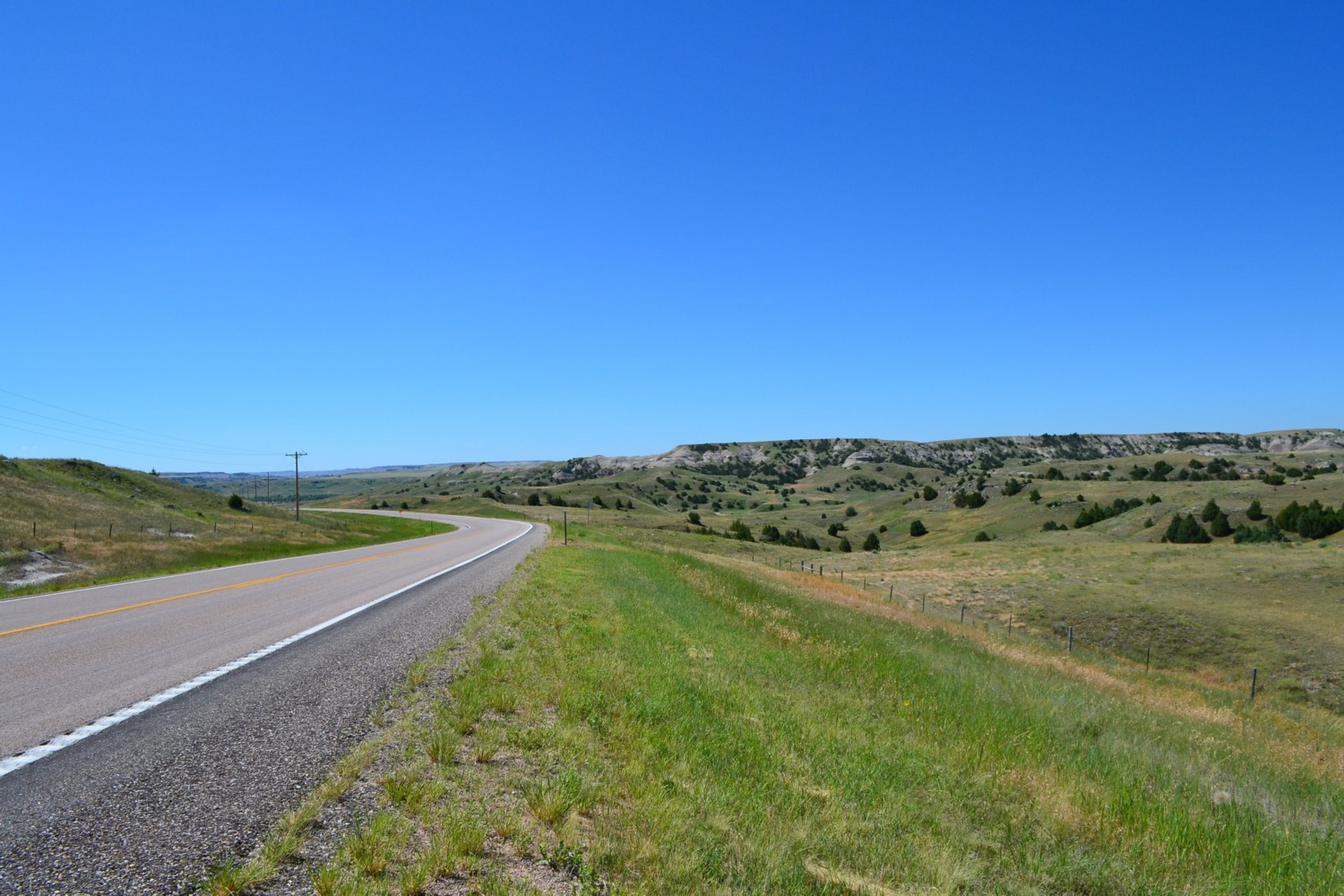
| Rt. 40 Heading South Toward the Pine Ride Reservation, SD |
Ian Frazier, in the opening paragraph of his book On the Rez (2000), writes: " 'Bleak' is the word attached in many people's minds to the idea of certain Indian reservations, of which the Oglala's reservation is perhaps the best example. Oddly, it is a word I have never heard used by Indians themselves."
![]() |
| The Town of Pine Ridge |
While the landscape itself betrays a sort of exquisite wild beauty, the fact that all this formidable emptiness is not some National Wilderness Area but is actually the 'reward' the Lakota got in defeat, the place where they're supposed to make their livelihood, makes "bleak" an appropriate adjective to use in describing it all. And certainly for many of the non-Indian visitors who sees it as bleak, shame no doubt informs that impression.
ND and I drove south from Rapid City on rt. 41, a long straight empty two lane bereft of traffic. Just after Red Shirt we pulled over to see the wares of a Lakota jewelry seller. He sat under a makeshift shelter on a bluff overlooking an expansive gash of Badlands that appeared where the grassy prairie fell away abruptly. We'd no sooner stopped and exchanged friendly greetings with the man when, from the opposite direction that we'd been going, a caravan of cars and vans pulled up in a calm-shattering hubbub of gravel-crunching and dust. The vehicles disgorged a chattering gaggle of doughy white people who proceeded to swarm around the small display of jewelry and then quickly fanned out across the overlook. Most of them gathered on the bluff overlooking the Badlands vista and arranged themselves into a "team" photo.
The suddenness of their arrival was jarring, their gaudy-colored clothes and their chattering shattered the silence, quashing the quiet, almost spiritual reverie that ND and I'd both felt when we'd initially stepped out of our car. They were Christians. Missionaries, actually, from Chattanooga, TN. Disturbing on so many levels. ND and I shrank into the background and watched the missionaries idly handle a necklace, some earrings, and make cursory sales talk with the Lakota man who responded in friendly tones and a kind expression. Eventually, the few shoppers went off to join their picture-snapping cohorts and we approached the jewelry maker again.
![]() |
| Tom the Lakota Artisan (right) with Lescaret |
On Leonard Peltier: "He took the fall. He didn't kill those FBI agents, the guy who did admitted it in prison, he was in for something else, but that guy is dead now. Leonard took the fall."
On the Crazy Horse Memorial being carved from a mountain near MT. Rushmore: "They were supposed to build a school for native people and they never did." And, about the profile of Crazy Horse (which is all there is yet): "It looks like George C. Scott."
On the Pine Ridge Reservation: "They took the Black Hills and gave us this ..." (gesturing out across the eroded fissure of Badlands).
On the symbolism of the turtle (used in several of his necklaces): "It means 'woman' because they carry the load on their backs."
On alcohol: "All it gets you is jail or detox, and I've had both."
We bought a few pieces of his work and asked him what a Lakota would say when saying good-bye.
"Dok-sha," he said, "it means 'we may meet again'."
Saturday, June 1, 2013
USSR in Color 1963
A collection of photographs of the USSR in 1963, in color. Photographer unknown. A long line of people waiting to see the embalmed body of Vladimir Lenin. It's hard to think of the USSR in color. Enemies are always black and white.
![]() |
| Red Square, Moscow, 1963, photographer unknown |
Friday, May 10, 2013
Atop Mt. Wachusett
Small patches of disgruntled snow still crusted some of the ski slopes but the main road to the summit (repaved last year) was clear. A fine spring day for climbing. Blue sky. Boston and Worcester visible in milky haze. The CIA and weather towers, fenced off, held no real menace. No raptors seen soaring on the thermals. No one else on top, a late Tuesday afternoon.
| View from the Summit |
Subscribe to:
Posts (Atom)