|
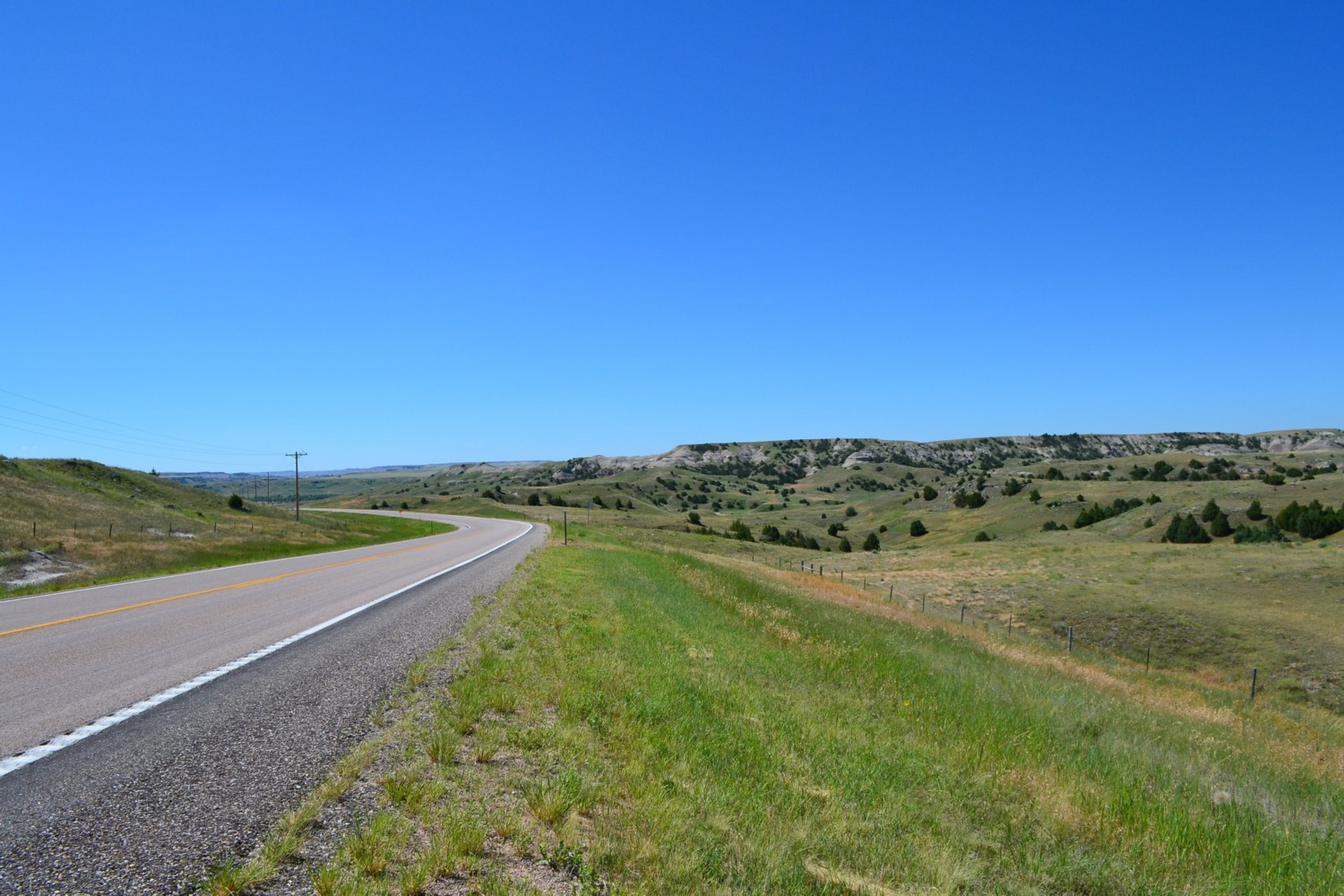
| Rt. 40 Heading South Toward the Pine Ride Reservation, SD |
Ian Frazier, in the opening paragraph of his book
On the Rez (2000), writes: " 'Bleak' is the word attached in many people's minds to the idea of certain Indian reservations, of which the Oglala's reservation is perhaps the best example. Oddly, it is a word I have never heard used by Indians themselves."
This is not surprising, I suppose. For those people not from Pine Ridge, particularly the proverbial white middle class American of mixed European ancestry (like myself who bears traces of Irish, French, German, and Danish bloodlines), Pine Ridge IS bleak. Long dun-colored plains and rolling hills stubbled with clusters of dark green tree growth. Vast swaths of emptiness. Occasional homesteads, often a trailer, surrounded by the debris of poverty - broken pick-up trucks, plastic buckets, piles of rusting machinery, haphazard fencing, clothes lines, scattered boards, masonry, other construction material, leaning sheds. Weary-looking towns like Pine Ridge itself, its main street ornamented by a Shell station and a Subway, piles of sand in the gutters.
 |
| The Town of Pine Ridge |
While the landscape itself betrays a sort of exquisite wild beauty, the fact that all this formidable emptiness is not some National Wilderness Area but is actually the 'reward' the Lakota got in defeat, the place where they're supposed to make their livelihood, makes "bleak" an appropriate adjective to use in describing it all. And certainly for many of the non-Indian visitors who sees it as bleak, shame no doubt informs that impression.

ND and I drove south from Rapid City on rt. 41, a long straight empty two lane bereft of traffic. Just after Red Shirt we pulled over to see the wares of a Lakota jewelry seller. He sat under a makeshift shelter on a bluff overlooking an expansive gash of Badlands that appeared where the grassy prairie fell away abruptly. We'd no sooner stopped and exchanged friendly greetings with the man when, from the opposite direction that we'd been going, a caravan of cars and vans pulled up in a calm-shattering hubbub of gravel-crunching and dust. The vehicles disgorged a chattering gaggle of doughy white people who proceeded to swarm around the small display of jewelry and then quickly fanned out across the overlook. Most of them gathered on the bluff overlooking the Badlands vista and arranged themselves into a "team" photo.
The suddenness of their arrival was jarring, their gaudy-colored clothes and their chattering shattered the silence, quashing the quiet, almost spiritual reverie that ND and I'd both felt when we'd initially stepped out of our car. They were Christians. Missionaries, actually, from Chattanooga, TN. Disturbing on so many levels. ND and I shrank into the background and watched the missionaries idly handle a necklace, some earrings, and make cursory sales talk with the Lakota man who responded in friendly tones and a kind expression. Eventually, the few shoppers went off to join their picture-snapping cohorts and we approached the jewelry maker again.
 |
| Tom the Lakota Artisan (right) with Lescaret |
His name was Tom, he lived in Red Shirt and he & his wife made Lakota necklaces & earrings that they sold here at the scenic overlook. Tom spoke in a soft and friendly tone, forthcoming and without a trace of rancor or suspicion. ND and I both were appalled by the Christians and said as much and Tom, without explicitly agreeing with our condemnation, stated that he himself was a full-blooded Lakota and that he lived and believed the Lakota ways. Our conversation was easy and friendly and Tom was more or less unguarded in offering his opinions.
On Leonard Peltier: "He took the fall. He didn't kill those FBI agents, the guy who did admitted it in prison, he was in for something else, but that guy is dead now. Leonard took the fall."
On the Crazy Horse Memorial being carved from a mountain near MT. Rushmore: "They were supposed to build a school for native people and they never did." And, about the profile of Crazy Horse (which is all there is yet): "It looks like George C. Scott."
On the Pine Ridge Reservation: "They took the Black Hills and gave us this ..." (gesturing out across the eroded fissure of Badlands).
On the symbolism of the turtle (used in several of his necklaces): "It means 'woman' because they carry the load on their backs."
On alcohol: "All it gets you is jail or detox, and I've had both."
We bought a few pieces of his work and asked him what a Lakota would say when saying good-bye.
"Dok-sha," he said, "it means 'we may meet again'."