Showing posts with label travel. Show all posts

Tuesday, November 11, 2014

Searching for Ancestors in Old Calabria

Monday, October 20, 2014

ND and I traveled to Lamezia Terme in the company of Miriam and Domenico, a young Italian couple in their mid twenties with whom we'd arranged a day of exploration in Nicastro and Decolattura, the towns of ND's ancestors on her father's side. We were on a quest to discover what we could of ND's great grandfather Vincenzo DiCello, her great grandmother Rosa Perri, and her great great grandfather, Salvatore DiCello.

Miriam, bright-eyed, speaks quite good English from having worked several years for Lufthansa Airlines in Milan. She lives in the small village of San Floro where she helps raise silkworms. Domenico, a photographer, looks like a young Cat Stevens. He doesn't speak much English though understands a fair amount; he has Miriam explain that he uses film and prints his images in a darkroom he created himself. Fairly aloof, almost bored-seeming, he's the opposite of Miriam's outgoing, smiling presence yet he drives the car all day without complaint, no small endeavor given Italian city traffic and the steep & narrow mountain roads we eventually traverse.

Nicastro was once its own village but has since been absorbed into the greater sprawl of Lamezia Terme, though "old Nicastro" still exists higher up the foothills of the southern Sila Mountains. We go first to the City Hall where Miriam has already arranged for us to view Vincenzo's 1886 birth certificate.

Approaching City Hall, Lamezia Terme, Calabria

In a nondescript office on the second floor, a helpful records keeper brings out a huge old ledger book and lays it on the counter for us to examine. The birth certificate is written in beautiful flowing script of a style no longer seen and reveals that Salvatore was a farmer and that young Vincenzo was born at home on a street in old Nicastro. The functionary makes a photocopy for us but privacy rules prevent us from photographing the entry and ledger.

Outside the office of birth and death certificates

From City Hall we go to something like a cultural library where we look through archived copies of an Italian journal from the 1970s that published articles and photographs about the Lamezia/Nicastro area. We don't find any references to the DiCellos but we do see photographs of Nicastro from the early 20th century and get a visual idea of what the town was like in the years just after Vincenzo left for America in 1898.

Before embarking for old Nicastro and the search for Vincenzo's neighborhood and birth street, Via Casalnuevo, we pause for an apertivo of Campari and prosecco at a local cafe, the Bar Mexican.

Fortifying ourselves before the venture into Old Nicastro

Neither Miriam nor Domenico know exactly where to go in our quest to find the street so we start asking people, beginning with two Italian policemen. Belying the image of gruff and perfunctory street cops the world over, these two guys are happy to offer directions and engage in chit chat. It turns out that one of them actually has a DiCello in his family.

Getting closer to the old neighborhood, we ask a pedestrian for clarification on how to find Via Casalnuevo. With authority, he offers concrete directions. Great, we think, we're getting close. Then we ask another person who, also with the voice of authority, directs us in a completely different direction. This happens several times and we realize that everyone knows exactly where everything is, even when they don't. Eventually, we abandon the car and set out on foot.

Downhill proves to be the wrong direction

The consensus is to go up

After more animated discussions with various locals we come to realize that, though we're asking about a particular street, "Casalnuevo" these days actually refers to an area rather than a specific Via. It's not uncommon, Miriam tells us, that over the course of a century not only do neighborhoods change physically but so do identifying names and references. Nevertheless, Casalnuevo, street or locale, lies uphill so up up uphill we go.

It seems like we're getting close

The neighborhood is an Escher-like labyrinth of two and three hundred year old houses of stone, tile, crumbling mortar, little windows and weathered wooden doors. The aura of Medieval time suffuses everything. I imagine myself wrapped in a sackcloth parading through the byways swinging a smoking censor, intoning plainsong.

Eventually, we pinpoint a few houses on what is now Via Niola and conclude that this is Vincenzo's block. The birth certificate had referenced # 3 but as we stand there deliberating which house is which, an old woman emerges from # 9 and Miriam starts talking with her. Then a man appears from around the corner and a lively conversation ensues. Though neither can say for certain if this street was indeed Via Casalnuevo, in our hearts we accept that it is.

In Vincenzo's neighborhood

Vincenzo's stoop?

Far above, crowning the neighborhood hillside, are the ruins of a Norman castle (circa 1500) that exists in the same state of decay as when Vincenzo lived here. We marvel at the thought that these 116 years later our eyes take in essentially the same sight as Vincenzo's eyes ("nothing changes here," Miriam declares). Could such images and perceived phenomena be somehow passed down through DNA or through some heretofore scientifically unknown means? Could ND in some way possess the "knowledge" of this place by having descended from the blood and sinew of her great grandfather? We gaze around with hungry imagination trying to absorb this place that in ways we don't really understand must be part of ND, and she part of it.

The Norman castle seen from the road leading out of Nicastro
and into the Sila Mountains

Then it's on to Decollatura, a commune (as such places are known in Italy), sort of an amalgam of little hamlets high in the Sila Mountains. Decollatura is the birthplace of Rosa Perri, ND's great grandmother, an ancestor about whom ND knows almost nothing. Winding winding winding up up up into wild forest, chestnut trees in abundance, crazy switchbacks, steep! Behind us the valley falls away, a wide swath of the Lamezia Terme urban expanse and, far in the hazy distance, the coast of the Tyrrhenian Sea. After an hour or so of pretty much steady climbing, we level out and then descend a short distance into a valley in which sits Decollotura.

Before meandering the town in search of the old streets where Rosa Perri resided, we go to the Hotel Caligiuri which has a restaurant offering a "menu tipico a base di funghi." We are in the heartland of porcini mushrooms. The restaurant includes mushrooms in every dish. We eat porcini carpaccio, porcini risotto, tortellini in a porcini mushroom cream sauce, a thick bean soup with chunks of mushrooms.

The porcini altar

For dessert, we peel apart roasted chestnuts, warm and mealy, another regional specialty that, Miriam tells us, are just coming into season now. A rich dark café (i.e., an espresso) and a chilled glass of Amaro saves me from the soporific daze of overeating and, after photographing the mushroom shrine at one end of the now empty restaurant, we convey our deep satisfaction to the jovial host and step outside.

The cool mountain air instantly refreshes us and we set out on foot in search of old Decollatura. Walking is wonderful though the main road is narrow and lacks a sidewalk. I'm mindful of cars and keep to the farthest edge but Miriam and Domenico walk side by side in the way I've noticed Italians do, as if pedestrian rights come first and passing cars must mind them instead of the other way around.

Though tree-lined the street isn't particularly picturesque - there's a small bread maker, a gas station, a car parts store. Domenico stoops to retrieve several very large nuts, acorns from an imposing old oak tree. He shows them to us and Miriam tells us that it's normal for people to gather acorns in abundance to feed the family pig. Most Calabrian families, at least in the countryside, keep a pig that ends up as homemade prosciutto, soppressata, salami, etc. Most families also grow grapes and make their own wine, and keep gardens with many vegetables - broccoli, chard, onions, potatoes. Fruit trees abound too, figs and lemons, pears and apricots. When you eat with a Calabrese family, "local" means a few steps outside the kitchen.

Local style

We come to Piazza Perri which marks the beginning of old Decollatura. Venturing into the streets just off the square is like stepping back in time - the 19th century, the 18th century, perhaps the Middle Ages. Only the electric lines and the occasional restored facade recall the present. Narrow cobbled streets, deeply weathered stone houses two and three stories high form ancient alleyways. It's late afternoon, the lowering sun casts rich light on the stonework and on the green garden plots that edge the hillside just beyond the neighborhood lanes. It is quiet in the way that predates Modernity. A dog barks in the far distance, a church bell chimes, a rusty door hinge creaks; no motors rev, no television noise leaks from behind the house walls.

From one of the side streets steps an old wrinkled Italian woman who could have emerged from one of the old B&W photographs that we saw earlier in the day, except she's in color; a blue and white cotton dress, a gray sweater, worn black shoes. Her silvery white hair frames a weathered face with deep set, cautiously suspicious eyes.

Because we're seeking any scrap of information about the Perri family, Miriam engages her in conversation. This sets off a spirited exchange in Italian and quickly involves another elderly signora making her way up the street with the aid of a cane, and then still another woman who peers out from a house twenty or so yards up the street wondering what the commotion is. Soon the women are shouting to each other in earnest discourse, an enthusiastic musical banter like course old cellos played with worn bows.

Sharing old knowledge

We move around the corner and another wizened matriarch appears and happily offers her old wisdom to the dialog. She's dressed all in black with a green apron tied around her stout waist and her eyes twinkle with mischief.


Eliciting old wisdom

Apparently we're standing on the very block in whose houses the Perri families lived ("Perri Lane" I think). A voice shouts down from a wrought iron balcony three stories above us; a very rotund woman seemingly missing a few teeth proffers her opinion on the colloquy taking place below.


The Perri Colloquy in old Decollatura

Eventually, a middle-aged man, studious in glasses, appears and joins the conversation. His voice is soft and intelligent and though much of what he says goes untranslated by Miriam we do learn that all of the Perris are gone now, either passed away or long since departed during the three great waves of emigration that took so many Calabrians away to America and Australia. The man had studied this, it seemed; the first dispersal came at the end of the 19th century with tens of thousands heading to the United States (ND's great grandfather had been part of this one); a second one took place soon after, in the first ten years of the 20th century; and a third great departure, with many going to Australia, took place in the 1930s.

This last fact, about emigration to Australia, explains why the first two women we spoke with kept thinking that ND and I were from Australia even though Miriam explained that actually we were from the United States. To these two ancient and venerable Calabrese matriarchs, the distinction didn't matter; Australia or America, there was really no difference, both were a world away from Perri Lane.


Old Decollatura


Thursday, January 9, 2014

Close to the Fireworks

The balcony on the 4th floor of the Hotel Odinsve provided a bird's eye view of the local neighborhood fireworks on New Years Eve in Reykjavik.

Tuesday, January 7, 2014

Iceland, No Irony in New Years Celebration

Arriving at the Hotel Odinsve, Reykjavik, 12/31/13

The New Years celebrations that go on in Iceland, particularly in Reykjavik, could never happen in the United States. They could never take place in a country that routinely bombs other countries, that has an aggressive military industrial complex, a country in which police violence is endemic. Not with the gusto on display in Iceland and on such a massive scale, essentially 24 hours of thunder and lightening. Oh wait, there are the 4th of July celebrations across the US, true. They are certainly ironic given our penchant for launching missiles from drones. But I digress.

Iceland celebrates with explosions. With rockets and flares and showers of colored sparks. And without irony. Iceland has no military and the first police killing of a civilian in the country's 50+ year history occurred last year. And the police apologized. So no, there's no irony in the great Nordic fiesta. Instead, there's fun, glee, impish delight in loud noises, civic rapport.

View from the 4th Floor Balcony

Fireworks are sold legally throughout the holiday period and sales are especially brisk on the day of New Years Eve. All the proceeds from fireworks sales go to the country's emergency response and search & rescue teams so buying, and setting off, fireworks is not only encouraged but something of a citizen's duty. Throughout Reykjavik and its suburban environs, explosions and flashes of light and sparkles of flame begin early in the day and continue on into the night, increasing in intensity as midnight approaches.

Just to be clear - you can buy powerful, commercial strength fireworks on the street in the city and set them off right there on the sidewalk, between the buildings, firing them aloft right above the neighborhood. This goes on all over town. You literally have to be careful where you walk for fear of rounding a corner and coming upon a box of bottle rockets about to launch.

Everyone is good-natured about the whole thing, whole families stroll the streets, groups of friends gather in bunches talking and drinking. Toward midnight everyone streams up Skólavörðustígur St heading to the Hallgrímskirkja, the towering church that sits atop a hill in central Reykjavik.
 Hallgrímskirkja
Normally I'm unnerved by thronging masses, particularly in America where decorum and civility can often go missing, but this crowd was, in as much as a crowd can be one thing, polite. Or maybe considerate. Certainly not threatening. Plenty of civility. And enough decorum to make the genuinely enthusiastic reveling charming rather than boorish.

I witnessed one scene that sort of epitomizes the consideration of the citizens. From our hotel room's top floor balcony I watched a father & son, later joined by the mother, emerge from their apartment building across the street. They carried a duffel bag-sized cache of fireworks which they set down on the sidewalk. A few feet farther on was the entrance to an iced-over parking lot and there the family began setting of their fireworks. First little fizzy ground sparklers, then hissing ground spinner things, then firecrackers in whole packs and long strings. Finally they got to the big stuff, the rockets. The fuses crackled with white sparks and then the rockets whizzed upward and exploded not 30 feet above where we stood on the balcony. A wild burst of volcanic energy of the kind that almost never manifests in the demeanor of an Icelander.

Scene of the Fireworks, December 31, 2013

When the explosions finished I cheered and whooped the way an American sports fan would but the family below kept silent, almost as if they'd committed a solemn task that shouldn't be profaned with raucous behavior. Without saying much to each other, they very carefully picked up all the debris from their little explosive fun and took it with them, back into their building. A few minutes later, the father re-emerged to pick up a final scrap of something he'd dropped. I was particularly impressed because it was very clear that these people were just ordinary conscientious Reykjavikians who cared about their city and who simply did the right thing. They didn't do what they did because they thought someone was watching, because they thought they would look good or would receive an offer to do a reality TV show about their lives. They were just being stewards of their neighborhood and, by extension, their country.

But I saw them. They moved me.

What I didn't see was a single policeman during the entire celebration. Granted, I didn't stay out until the wee hours but I was out for the hubbub of the night, the main event. In America, the police presence would have been massive. And no one would have dared light off a firecracker. In America, the police shoot people everyday. But here, in Iceland's capital, with public drinking in the streets and amateur pyrotechnics setting the sky ablaze, not one uniformed official appeared in the midst.

That, I realized, was real freedom.

Saturday, July 27, 2013

Pine Ridge Reservation, South Dakota, Part I

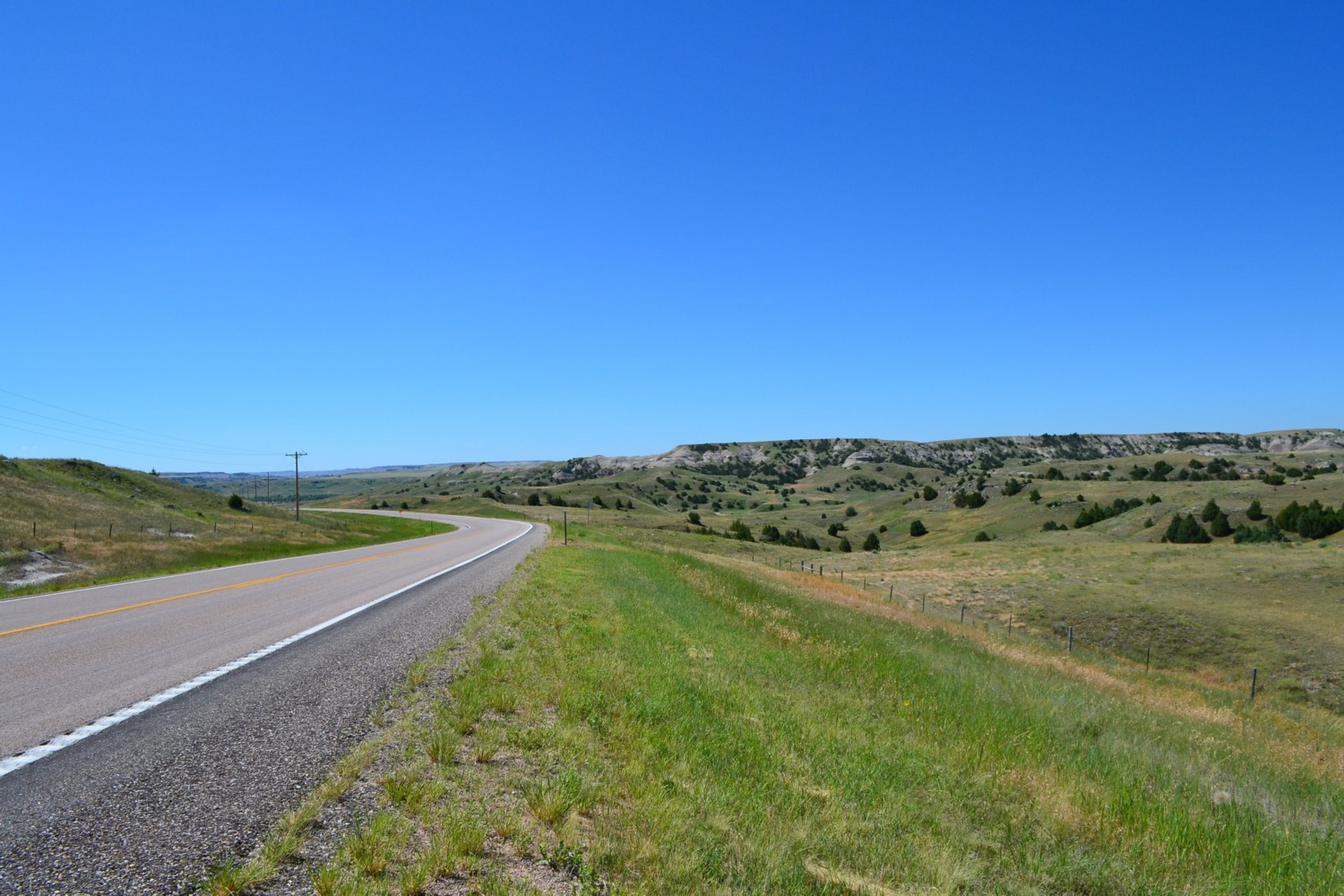
Rt. 40 Heading South Toward the Pine Ride Reservation, SD

Ian Frazier, in the opening paragraph of his book On the Rez (2000), writes: " 'Bleak' is the word attached in many people's minds to the idea of certain Indian reservations, of which the Oglala's reservation is perhaps the best example. Oddly, it is a word I have never heard used by Indians themselves."

This is not surprising, I suppose. For those people not from Pine Ridge, particularly the proverbial white middle class American of mixed European ancestry (like myself who bears traces of Irish, French, German, and Danish bloodlines), Pine Ridge IS bleak. Long dun-colored plains and rolling hills stubbled with clusters of dark green tree growth. Vast swaths of emptiness. Occasional homesteads, often a trailer, surrounded by the debris of poverty - broken pick-up trucks, plastic buckets, piles of rusting machinery, haphazard fencing, clothes lines, scattered boards, masonry, other construction material, leaning sheds. Weary-looking towns like Pine Ridge itself, its main street ornamented by a Shell station and a Subway, piles of sand in the gutters.

The Town of Pine Ridge

While the landscape itself betrays a sort of exquisite wild beauty, the fact that all this formidable emptiness is not some National Wilderness Area but is actually the 'reward' the Lakota got in defeat, the place where they're supposed to make their livelihood, makes "bleak" an appropriate adjective to use in describing it all. And certainly for many of the non-Indian visitors who sees it as bleak, shame no doubt informs that impression.

ND and I drove south from Rapid City on rt. 41, a long straight empty two lane bereft of traffic. Just after Red Shirt we pulled over to see the wares of a Lakota jewelry seller. He sat under a makeshift shelter on a bluff overlooking an expansive gash of Badlands that appeared where the grassy prairie fell away abruptly. We'd no sooner stopped and exchanged friendly greetings with the man when, from the opposite direction that we'd been going, a caravan of cars and vans pulled up in a calm-shattering hubbub of gravel-crunching and dust. The vehicles disgorged a chattering gaggle of doughy white people who proceeded to swarm around the small display of jewelry and then quickly fanned out across the overlook. Most of them gathered on the bluff overlooking the Badlands vista and arranged themselves into a "team" photo.

The suddenness of their arrival was jarring, their gaudy-colored clothes and their chattering shattered the silence, quashing the quiet, almost spiritual reverie that ND and I'd both felt when we'd initially stepped out of our car. They were Christians. Missionaries, actually, from Chattanooga, TN. Disturbing on so many levels. ND and I shrank into the background and watched the missionaries idly handle a necklace, some earrings, and make cursory sales talk with the Lakota man who responded in friendly tones and a kind expression. Eventually, the few shoppers went off to join their picture-snapping cohorts and we approached the jewelry maker again.

Tom the Lakota Artisan (right) with Lescaret
His name was Tom, he lived in Red Shirt and he & his wife made Lakota necklaces & earrings that they sold here at the scenic overlook. Tom spoke in a soft and friendly tone, forthcoming and without a trace of rancor or suspicion. ND and I both were appalled by the Christians and said as much and Tom, without explicitly agreeing with our condemnation, stated that he himself was a full-blooded Lakota and that he lived and believed the Lakota ways. Our conversation was easy and friendly and Tom was more or less unguarded in offering his opinions.

On Leonard Peltier: "He took the fall. He didn't kill those FBI agents, the guy who did admitted it in prison, he was in for something else, but that guy is dead now. Leonard took the fall."

On the Crazy Horse Memorial being carved from a mountain near MT. Rushmore: "They were supposed to build a school for native people and they never did." And, about the profile of Crazy Horse (which is all there is yet): "It looks like George C. Scott."

On the Pine Ridge Reservation: "They took the Black Hills and gave us this ..." (gesturing out across the eroded fissure of Badlands).

On the symbolism of the turtle (used in several of his necklaces): "It means 'woman' because they carry the load on their backs."

On alcohol: "All it gets you is jail or detox, and I've had both."

We bought a few pieces of his work and asked him what a Lakota would say when saying good-bye.

"Dok-sha," he said, "it means 'we may meet again'."


Wednesday, December 5, 2012

Kunsthistorisches Museum, Vienna

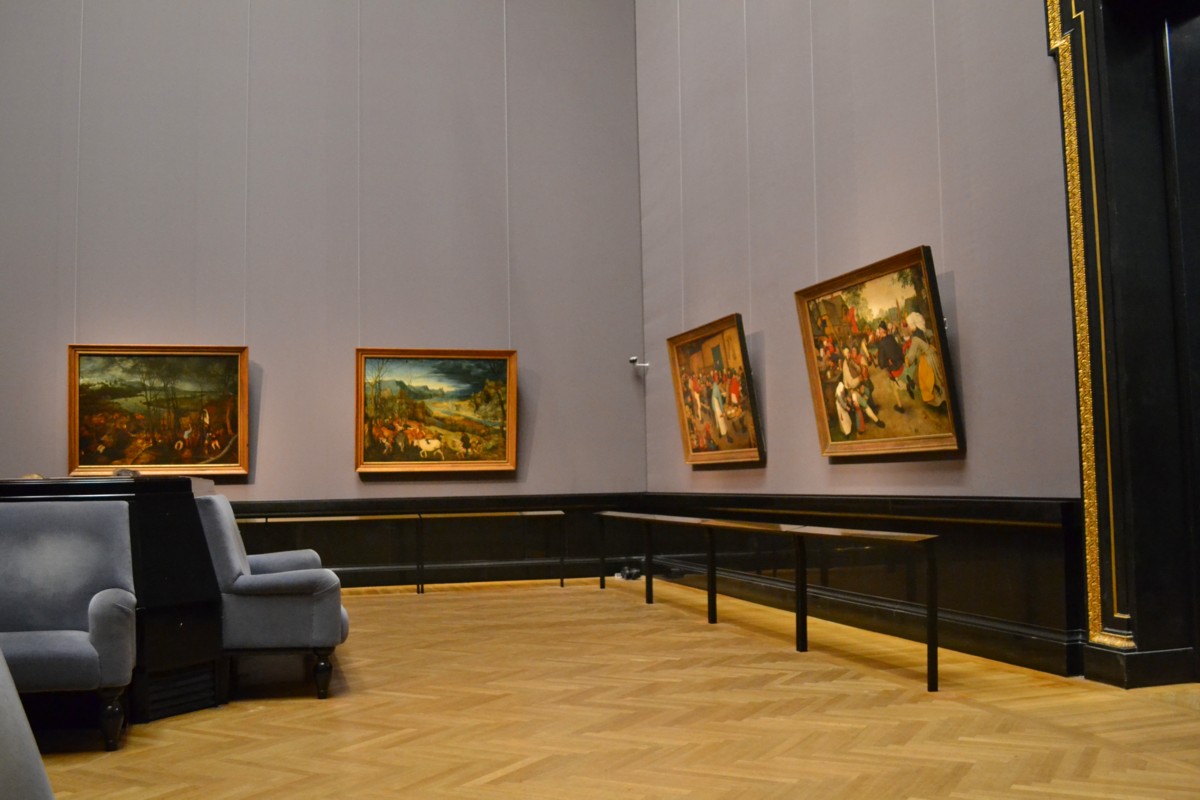
There are many reasons to visit the Kunsthistorisches Museum in Vienna, but I went with a single purpose in mind: to see the extraordinary collection of paintings by Pieter Bruegel the Elder. There are more of Bruegel's great paintings gathered here than anywhere else in the world and they can be viewed in the Bruegel room, Salle X of the Picture Gallery. These are paintings of breadth and grand sweep down the ages, they have charmed and haunted viewers for hundreds of years. Today, you can be with them, you can sit on comfortable couches nearby and look at them for as long as you like, you can study them in comfort.

Bruegel Room, Salle X

I visited in November, on an overcast Sunday, just before noon. The museum was not very busy. In fact, for brief moments I was alone in Room X, not even a museum guard in casual surveillance. Just me and Hunters in the Snow and Peasant Dance and Tower of Babel. Just me and Bruegel's 445 year old vision.  Oddly, two additional Bruegel Works, the playful Children's Games and the wild Fight Between Carnival and Lent, were in a special room and shared gallery space with a temporary exhibition of work by Ed Ruscha, a somewhat incongruous pairing. But no matter.

Thursday, December 15, 2011

Adieu, Mr. Whitman

George Whitman, bookseller extraordinaire, friend of writers and travelers, mischievous raconteur, proprietor of the iconic Shakespeare & Co. in Paris (so named in honor of Sylvia Beach's original Parisian bookshop), has passed on.

Many Parisian travelers, writers, artists, wayfarers have personal anecdotes of their encounters with George Whitman. As do I.

In 1990, my traveling companion and I found ourselves in a Paris we couldn't afford and were on the cusp of having to abandon the city. A friend of mine had told us before going that sometimes the Shakespeare & Co. Bookstore put people up for free. Being a bookseller myself at the time, we thought it was worth a shot.

                                                       Miguel Medina/AFP/Getty Images

The unmistakable George Whitman sat behind a cluttered desk in an entire room of cluttered bookshelves. I approached him.

"Hello," I said, "I was told that sometimes travelers could stay here and I was wondering ...."

"NO!" he shouted before I could even finish my sentence. "That's a lie! You can't stay here!"

I was so taken aback, I didn't argue and instead just turned away. So much for that idea, I thought.

But being in such a jumbled, ramshackle bookshop had its charm and my companion and I stayed and browsed, fading into the background chaos of the towering stacks, the stacked pillars of books, the jumbled variety of printed matter. This was a serious bookstore, there were no postcards or souvenir Eiffel Towers or T shirts for sale.

I've been a collector of Beat Generation literature since I was a young man and so always look for works by the Beat writers, the famous - Ginsberg, Kerouac, Corso, Burroughs; the not as famous - John Wieners, Lew Welch, Philip Lamantia; and those on the periphery of Beat - Brautigan, Rexroth, Kesey, etc. That day, in Shakespeare & Co., in a box of broadsides and various pamphlets and small press publications, I came upon a stapled edition of poems by Jack Hirschman, one of those peripheral Beats whose actual work I didn't much know but whose name I did. I've forgotten what small edition it was, some chapbook, but it did not have a price in it and I knew that I didn't already own it so I thought if they didn't want too much for it, I'd buy it.

I took it over the George Whitman. "How much do you want for this?" I asked, and handed it to him.

He looked at it. "Hirschman?" he said, "you know Hirschman?"

Without another word, he opened the top drawer of the desk, took out a key on a brass key chain, and handed it to me.

"The key is to the small library, top of the stairs, 1st floor, to the right. You can stay there. See me after you get settled, you'll have to cover the desk while I go out later."

Just like that.

For three days, my companion and I slept in a tiny narrow bed in the "library," a room packed floor to ceiling with not-for-sale books, mostly first editions of the greats - Hemingway, Joyce, Pound, Baldwin, Burroughs, Miller, Nin, Stein. It was like sleeping in a rare book vault. And it was free - excepting the few hours I sat behind the desk and did what came naturally at the time, selling books.

For George Whitman's generosity and his tireless encouragement of literature and the avant-garde (even in the smallest gestures such as rewarding my interest in a writer he, George, deemed worthy, by helping me and my friend), I will always be grateful.

Out the small window of our room we could look down on the sidewalk in front of the shop and the Seine and, to the right, the weighty face of Notre Dame. I will never know Paris again as I knew it then, in 1990, sheltered under the creaking eaves of George Whitman's book palace and writers' refuge, the magnificent Shakespeare & Co.

Adieu, Mr. Whitman, and merci beaucoup.

Wednesday, March 30, 2011

Waitukubuli Trail End to End

Great news out of Dominica. The first two native Dominicans to hike the entire Waitukubuli Trail end to end have finished their trek. Congratulations to Jerry Brisbane and Clement Rabess.


Saturday, January 22, 2011

Old San Juan


Africa, Old San Juan, December 2010

... narrow purplish-blue cobbled streets lined by gorgeous Spanish colonial architecture; carved wooden bar windows, ornate balconies; windows and doorways at street level open behind bars and grates, apartment insides visible beyond; facades of soft blues, peaches, ochers, washed-out greens; decorative clay wall scones, a brass lion mane door knocker.


Outside the Ramparts

Friday, July 23, 2010

Colossus of Maroussi

New Directions is re-issuing Henry Miller's The Colossus of Maroussi, one of his lesser known books, yet one of his finest. Richard Rayner of the Los Angeles Times writes a good piece on it. He plucks some terrific quotes from the book that illustrate well the enthusiasm and vigor that Miller brought to this work. Rayner also succinctly brings into focus the lineage that Miller established:

"The incantatory style, with its rolling sub-clauses, mixed Hemingway and D.H. Lawrence in a way that was fresh at the time; it seems familiar now because it predicts Kerouac, Ginsberg and Snyder. Like the Beats who would follow him, Miller looked out for the possibilities of human holiness. Like them, he embraced risk and never minded going over the top."

Well worth checking out.

Tuesday, June 22, 2010

Biking Martha's Vineyard, Part I

Biking Martha’s Vineyard can be vexing at times - intersections clogged with cars and tourists, inexperienced and inattentive bike rental bikers, stiff headwinds – but the rewards of cycling here are many and varied. I had the good fortune of experiencing it firsthand this past weekend.
Two friends and I accepted a standing invitation to visit old friend and musician Kevin Keady who, in addition to writing and performing uniquely insightful folk songs, works on the Pimpney Mouse Farm, “The Last Farm on Chappaquiddick” (which it is and which is also the title of a recent book documenting the farm’s history in the 30s and 40s and written by the farm’s matriarch, Edo Potter).
Pimpney Mouse Farm is a working hay farm encompassing several hundred acres of some of the most beautiful and classic landscape to be found on the eastern seaboard. Kevin happened into employment here nearly two decades ago and in the interim time has become a fixture not only on the farm but on the Vineyard itself. Generous, motivated, a devotee of his art and a tireless promoter of the local music scene, Kevin hosted our three person cycling squad at his small cabin (known simply as “Camp”) on the far end of the farm, the most private area, the section beyond which is nothing but fields and vistas down to Poucha Pond and the Atlantic Ocean beyond East Beach.
Our cycling goal was simple – ride from one end of the Vineyard to the other and explore the back roads in between. Starting at the end of the farm’s long dusty sandy driveway and taking Chappy’s only paved road to the three car ferry across the cut to Edgartown, we set out for the far southwestern headland of Aquinnah (also known as Gay Head) with its cliffs and lighthouse and views across the water to the Elizabeth Islands and Cutty Hunk. It was Saturday, the sun was bright in a cloudless blue sky, and we had the whole day ahead for our cycling meander.
Three main roads head across the island from Edgartown, all with parallel bike paths so that it’s possible, for the most part, to stay clear of roadway traffic. Vineyard Haven Road skirts the seaside congestion of Oak Bluffs but as a result is also one of the island’s busiest thoroughfares, used extensively by the locals. The shore route through Oak Bluffs (Beach Road, New York Ave to Vineyard Haven) is also busy but in a more sightseeing manner with lines of tourist cars snaking through Oak Bluffs and Vineyard Haven or angling for a parking spots along the beach straightaway across from Sengekontacket Pond. The Edgartown-West Tisbury Road along the southern side of the Vineyard is generally less busy and though not exactly scenic it does have a fine shaded bike path that runs through pine forest (with the result that sections of the path are blanketed with burnished carroty/orange dried pine needles).
But limiting your cycling to the above-mentioned roads and sticking to the fatted center of the Vineyard is not recommended. Instead, head west, southwest actually, to the Massif Central (so I dubbed it in my mind) otherwise known as West Tisbury and Chilmark where we pedaled with enthusiasm along nearly empty rolling byways.Three island roads in particular stand out.

Lamberts Cove Rd is on the right off State Road coming out of Vineyard Haven. It’s a beautifully paved, winding country road in West Tisbury that takes you by old property and woodland idylls – hoary old dignified stone walls demarcating fields and wood edges, stalwart and massive oaks growing for a century and more, ancient fresh water ponds (Seth’s and Duarte’s), mown fields, road shoulder thickets. Very little traffic. 
The second must-ride street is Middle Road through Chilmark – the “Chilmark Alps” I joke with Leonator and the Virginian, my estimable riding companions. Even more up and down than Lamberts Cove, this longish (3 – 4 miles) road bypasses the far busier South Road, the preferred way for auto traffic to get to Aquinnah. Middle Road is flawlessly paved too and runs through some of the same gorgeous countryside as Lamberts Cove except in Chilmark there seems to be more open space, more farm fields and stone walls. Toward the far end it becomes visually apparent that Middle Road unfolds along the higher spine of the peninsula that marks the southern geography of the Vineyard. Off to the left we catch glimpses of the sea.

The third and final must-ride road is Moshup Trail, another little-traffic’d route that allows you to bypass the more congested State Rd in the run up to the Aquinnah headland. “Mash It Up Road!” we joke, doing our best Rasta imitations while cruising along one more finely surfaced roadway, this one going down to sea level and running through the dunes and sandy landscape hills that separate the road from the ocean to the south.
But those are specific roads. I offer a blanket endorsement of the Menemsha Pond basin, also on the Aquinnah peninsula. Take Lighthouse Rd down to Lobsterville Beach and then along West Basin Road to the Bike Ferry. Yes, a bike ferry that, for $5 per person, takes you across the cut that separates the traveler on West Basin Road from the small fishing village of Menemsha. Fantastic dune landscape, flat beachscape, faded fishing shack grays and washed out pinks and blues, scrub green sand soil hillocks, the ocean.
In Menemsha, we ride down the port road and pass several fish markets, behind which, on the salty-gray plank docks, hungry diners sit on creaky picnic benches eating something I can only assume is fresh, hot, and delicious. Mental note taken – return to this little hamlet for outstanding fresh seafood!

Take North Road out of Menemsha – it parallels aforementioned Middle Road and, while not quite as transcendent as Middle Road, still manages to conjure images of Languedoc in rural southern France. In fact, all along this extraordinary ride I think of France, of the upcoming Tour, of the simple joy and unadulterated sense of goodness that comes from riding a bicycle through new and remarkable places.