While Stalin deliberately starved the Ukraine in the 1930s, Intourist, the Soviet tourist agency, created alluring travel posters in the hopes of attracting visitors to the worker's paradise.
See more vintage Soviet travel images.
Sunday, February 10, 2013
Sunday, February 3, 2013
The Evil Empire
When Ronald Reagan, in a speech to the National Association of Evangelicals in Orlando, Florida in 1983, referred to the Soviet Union as "an evil empire," it seemed like just more of Reagan's hyperbole. Reagan, after all, was full of political bluster and calculation; the assignation of a phrase from a popular science fiction movie to America's Cold War enemy bordered on the puerile, and many took it as such.
Very few people on the Left at the time harbored any illusions about the lack of political, personal, and artistic freedom in the Soviet Union, or any of the Eastern Bloc countries. But it was impossible at the time, at least for the American Left, to applaud Reagan for his anti-USSR stridency. There was something to be mistrusted in his hubris and it was already clear by 1983 that, in the name of anti-Communism, Reagan was willing to unleash the most undemocratic forces and countenance unthinkable atrocities carried out by US allies like El Salvador and Guatemala. There was something distinctly unpalatable about a man willing to engage in such high level moral posturing while egregious human rights abuses were being carried out in Central America with his Administration's complicity.
However, now, with the clarity of hindsight and buttressed by contemporary scholarship, we can say that Reagan was certainly right in his characterization of the Soviet Union as an "evil empire." At the same time, condemning the means that Reagan employed to combat said evil empire (by waging proxy wars in Central America, for example) remains as valid today as it was then. The East/West battlegrounds in El Salvador, Guatemala, Nicaragua, Grenada still do not fit neatly into the Cold War paradigm; each country's internecine struggles must be analyzed independently, taking into account the particulars of each country and each country's regrettable histories of colonial genocide, capitalist exploitation, and entrenched poverty. To categorize the struggles in those countries as a global Communist conspiracy emanating from and directed by Moscow, as Reagan did time and again, even today does not hold up to honest scrutiny.
Yet still. The Soviet Union was an evil empire and two recent works of scholarship document, with unsparing detail and exhaustive research, just how evil it was.

Anne Applebaum's Iron Curtain: The Crushing of Eastern Europe 1944-1956 thoroughly documents the Soviet-led subjugation of Eastern Europe in the aftermath of the second world war. She pays particular attention to the fates of Poland, Hungary, and East Germany and uses extensive recently available archival evidence to document the extent of the terror employed in enslaving these countries. The book is grim and compelling, enraging and depressing, but it manages to do what I imagine an historian always hopes for her book to do - it enhances understanding and greatly expands the knowledge of its subject.
***
If possible, Timothy Snyder's Bloodlands: Europe Between Hitler and Stalin is grimmer and even more shocking than Applebaum's work. In Bloodlands, Snyder sets out to document how "[I]n the middle of Europe in the middle of the twentieth century, the Nazi and Soviet regimes murdered some fourteen million people." Where this mass slaughter occurred "extends from central Poland to western Russia, through Ukraine, Belarus, and the Baltic States," what Snyder names the "Bloodlands." In a feat of commendable journalistic skill, Snyder manages not only to situate the scope and scale of these mass killings in the historical record but personalizes the atrocities as well. Snyder, too, uses much archival evidence that has come to light since the fall of Soviet Communism and includes many personal stories and individual experiences of the indescribably heinous, yes Evil, acts perpetrated on such a massive scale by the USSR.
Snyder's book, as its title suggests, focuses on both the Nazis and the Soviets and those two towering pillars of Sadism, Adolf Hitler and Joseph Stalin. Though Hitler is often held up as the exemplar of Pure Evil, after just a few chapters of Snyder's book one could be forgiven for coming to believe that Stalin was very much Hitler's equal, that he was in fact perhaps the worse of the two. Stalin, for example, surpassed Hitler in the sheer numbers of people murdered and was equally obsessed with destroying entire populations. Though perhaps longevity accounts for Stalin's "success" (he ruled far longer than Hitler), still it takes a special kind of evil to put in place policies that, for example, in the Ukraine in the 1930s, deliberately induced famine that resulted in upwards of a million deaths by starvation.
Both these valuable books narrate crimes against humanity committed on a scale that, but for the documentary evidence, are unimaginable. Yet they occurred. And while it is irrelevant who was worse, Stalin or Hitler, what both authors make perfectly clear is that the Soviet Union truly was "an evil empire."
Very few people on the Left at the time harbored any illusions about the lack of political, personal, and artistic freedom in the Soviet Union, or any of the Eastern Bloc countries. But it was impossible at the time, at least for the American Left, to applaud Reagan for his anti-USSR stridency. There was something to be mistrusted in his hubris and it was already clear by 1983 that, in the name of anti-Communism, Reagan was willing to unleash the most undemocratic forces and countenance unthinkable atrocities carried out by US allies like El Salvador and Guatemala. There was something distinctly unpalatable about a man willing to engage in such high level moral posturing while egregious human rights abuses were being carried out in Central America with his Administration's complicity.
However, now, with the clarity of hindsight and buttressed by contemporary scholarship, we can say that Reagan was certainly right in his characterization of the Soviet Union as an "evil empire." At the same time, condemning the means that Reagan employed to combat said evil empire (by waging proxy wars in Central America, for example) remains as valid today as it was then. The East/West battlegrounds in El Salvador, Guatemala, Nicaragua, Grenada still do not fit neatly into the Cold War paradigm; each country's internecine struggles must be analyzed independently, taking into account the particulars of each country and each country's regrettable histories of colonial genocide, capitalist exploitation, and entrenched poverty. To categorize the struggles in those countries as a global Communist conspiracy emanating from and directed by Moscow, as Reagan did time and again, even today does not hold up to honest scrutiny.
Yet still. The Soviet Union was an evil empire and two recent works of scholarship document, with unsparing detail and exhaustive research, just how evil it was.

Anne Applebaum's Iron Curtain: The Crushing of Eastern Europe 1944-1956 thoroughly documents the Soviet-led subjugation of Eastern Europe in the aftermath of the second world war. She pays particular attention to the fates of Poland, Hungary, and East Germany and uses extensive recently available archival evidence to document the extent of the terror employed in enslaving these countries. The book is grim and compelling, enraging and depressing, but it manages to do what I imagine an historian always hopes for her book to do - it enhances understanding and greatly expands the knowledge of its subject.
***
If possible, Timothy Snyder's Bloodlands: Europe Between Hitler and Stalin is grimmer and even more shocking than Applebaum's work. In Bloodlands, Snyder sets out to document how "[I]n the middle of Europe in the middle of the twentieth century, the Nazi and Soviet regimes murdered some fourteen million people." Where this mass slaughter occurred "extends from central Poland to western Russia, through Ukraine, Belarus, and the Baltic States," what Snyder names the "Bloodlands." In a feat of commendable journalistic skill, Snyder manages not only to situate the scope and scale of these mass killings in the historical record but personalizes the atrocities as well. Snyder, too, uses much archival evidence that has come to light since the fall of Soviet Communism and includes many personal stories and individual experiences of the indescribably heinous, yes Evil, acts perpetrated on such a massive scale by the USSR.
Snyder's book, as its title suggests, focuses on both the Nazis and the Soviets and those two towering pillars of Sadism, Adolf Hitler and Joseph Stalin. Though Hitler is often held up as the exemplar of Pure Evil, after just a few chapters of Snyder's book one could be forgiven for coming to believe that Stalin was very much Hitler's equal, that he was in fact perhaps the worse of the two. Stalin, for example, surpassed Hitler in the sheer numbers of people murdered and was equally obsessed with destroying entire populations. Though perhaps longevity accounts for Stalin's "success" (he ruled far longer than Hitler), still it takes a special kind of evil to put in place policies that, for example, in the Ukraine in the 1930s, deliberately induced famine that resulted in upwards of a million deaths by starvation.
Both these valuable books narrate crimes against humanity committed on a scale that, but for the documentary evidence, are unimaginable. Yet they occurred. And while it is irrelevant who was worse, Stalin or Hitler, what both authors make perfectly clear is that the Soviet Union truly was "an evil empire."
Labels:
Cold War,
Communism,
History,
Soviet Union,
USSR
Wednesday, December 5, 2012
Kunsthistorisches Museum, Vienna
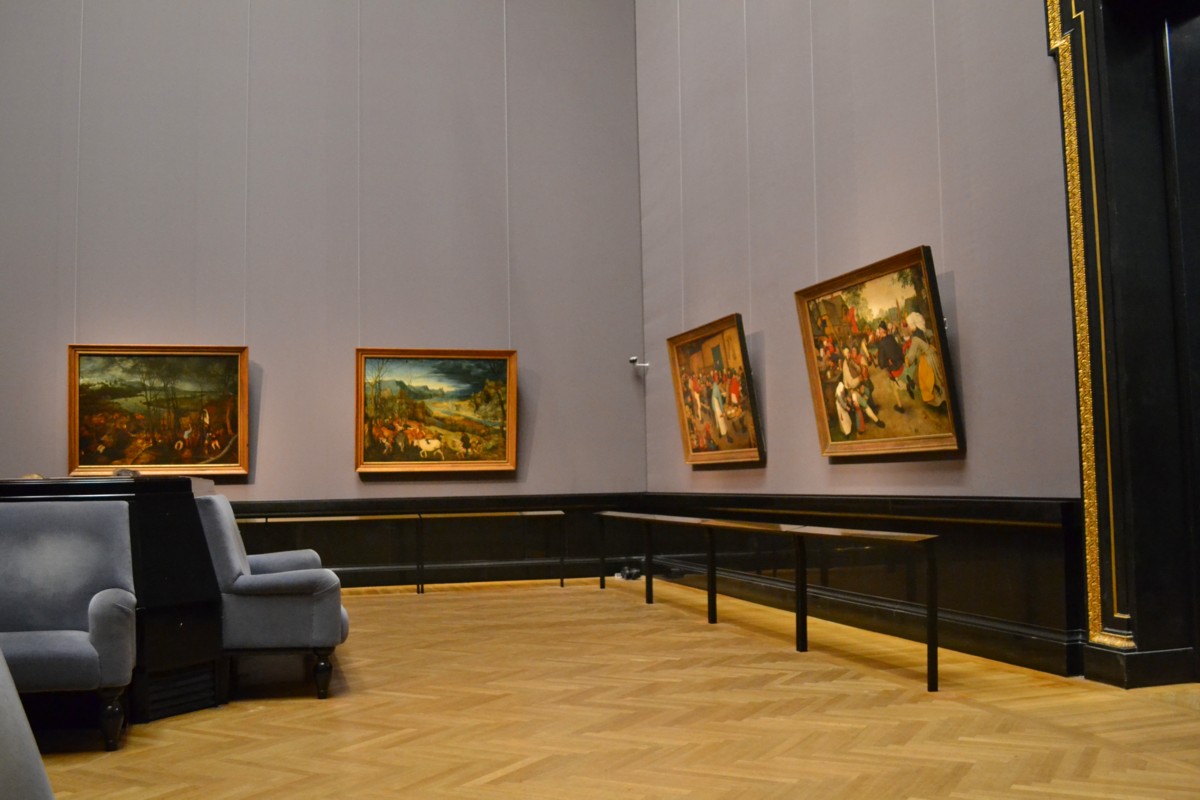
There are many reasons to visit the Kunsthistorisches Museum in Vienna, but I went with a single purpose in mind: to see the extraordinary collection of paintings by Pieter Bruegel the Elder. There are more of Bruegel's great paintings gathered here than anywhere else in the world and they can be viewed in the Bruegel room, Salle X of the Picture Gallery. These are paintings of breadth and grand sweep down the ages, they have charmed and haunted viewers for hundreds of years. Today, you can be with them, you can sit on comfortable couches nearby and look at them for as long as you like, you can study them in comfort.
I visited in November, on an overcast Sunday, just before noon. The museum was not very busy. In fact, for brief moments I was alone in Room X, not even a museum guard in casual surveillance. Just me and Hunters in the Snow and Peasant Dance and Tower of Babel. Just me and Bruegel's 445 year old vision. Oddly, two additional Bruegel Works, the playful Children's Games and the wild Fight Between Carnival and Lent, were in a special room and shared gallery space with a temporary exhibition of work by Ed Ruscha, a somewhat incongruous pairing. But no matter.
![]() |
| Bruegel Room, Salle X |
I visited in November, on an overcast Sunday, just before noon. The museum was not very busy. In fact, for brief moments I was alone in Room X, not even a museum guard in casual surveillance. Just me and Hunters in the Snow and Peasant Dance and Tower of Babel. Just me and Bruegel's 445 year old vision. Oddly, two additional Bruegel Works, the playful Children's Games and the wild Fight Between Carnival and Lent, were in a special room and shared gallery space with a temporary exhibition of work by Ed Ruscha, a somewhat incongruous pairing. But no matter.
Labels:
art,
Bruegel the Elder,
Europe,
Kunsthistorisches Museum,
Painting,
travel,
Vienna
Saturday, November 24, 2012
Haunted Lion
Budapest
Absorbing memories I'll never remember, there is only mist, the
silhouettes of ghosts
fair trade products in a global economy of loss
cobblestones wet with laughter, with the lightness
of being ephemeral
like an insect
like the gossamer web of spiders starving for lack of flies
Somewhere I wrote it down, or tried to, or meant to,
notebooks obsessed with retaining what cannot be retained,
the Danube flows inexorably through history's banality,
commissars regimes kings queens popes of absurdity,
only Art mounts a real challenge to dissipation, to the
rotting of shoes and the cough of Power, stark words
etched sentence by sentence, paint strokes against decay,
raw sculpture against the elements.
Fate decides otherwise. Fickle belief. Ideologies drift
like poisonous pollen until the bees sicken and die.
Blood on rock. Castles of hubris, the court jester
has always mocked the king. Disdain bears no allegiance.
Crowns rust. Chintz in the second hand shop. Topple
the busts from their pedestals. Sheer the sheep
for their wool time and time again 'til the crowd
bellows for mutton. Listen to the fat sizzling in the fire.
Absorbing memories I'll never remember, there is only mist, the
silhouettes of ghosts
fair trade products in a global economy of loss
cobblestones wet with laughter, with the lightness
of being ephemeral
like an insect
like the gossamer web of spiders starving for lack of flies
Somewhere I wrote it down, or tried to, or meant to,
notebooks obsessed with retaining what cannot be retained,
the Danube flows inexorably through history's banality,
commissars regimes kings queens popes of absurdity,
only Art mounts a real challenge to dissipation, to the
rotting of shoes and the cough of Power, stark words
etched sentence by sentence, paint strokes against decay,
raw sculpture against the elements.
Fate decides otherwise. Fickle belief. Ideologies drift
like poisonous pollen until the bees sicken and die.
Blood on rock. Castles of hubris, the court jester
has always mocked the king. Disdain bears no allegiance.
Crowns rust. Chintz in the second hand shop. Topple
the busts from their pedestals. Sheer the sheep
for their wool time and time again 'til the crowd
bellows for mutton. Listen to the fat sizzling in the fire.
![]() |
| Budapest, 2012 |
Looking for Ginsberg in Hungary
There's a row of used book shops on Karoly Ut in Budapest, venerable shops with handsome collections of Hungarian volumes of many kinds and subject matter. In particular, I went looking for Allen Ginsberg and found two copies of A Leples Bitang (The Shrouded Stranger).
Ginsberg was popular and appreciated in Hungary, his intrinsic message of individual freedom resonated with Hungarian youth, writers, and artists who lived under Communist dictatorship. With poetry celebrating democratic sensibilities and championing free expression, Allen Ginsberg was well-represented in Hungarian publications, aided by the enthusiastic translations of Eorsi Istvan.
The volumes, in hardback, cost 800 and 1000 forint respectively (approximately $4-5 each).
Ginsberg was popular and appreciated in Hungary, his intrinsic message of individual freedom resonated with Hungarian youth, writers, and artists who lived under Communist dictatorship. With poetry celebrating democratic sensibilities and championing free expression, Allen Ginsberg was well-represented in Hungarian publications, aided by the enthusiastic translations of Eorsi Istvan.
The volumes, in hardback, cost 800 and 1000 forint respectively (approximately $4-5 each).
Labels:
Allen Ginsberg,
Beat Generation,
Budapest,
Eorsi Istvan,
Hungary
Thursday, May 3, 2012
Monday, February 20, 2012
Norman Mailer and Bantu Philosophy
Norman Mailer, in The Fight, his book on the Ali-Foreman fight in Zaire in 1974 ("The Rumble in the Jungle") writes about his encounter with the ideas of Bantu philosophy:
"Given a few of his own ideas, Norman's excitement was not small as he read Bantu Philosophy. For he discovered that the instinctive philosophy of African tribesmen happened to be close to his own. Bantu philosophy, he soon learned, saw humans as forces, not beings. Without putting it into words, he had always believed that. It gave a powerful shift to his thoughts. By such logic, men or women were more than the parts of themselves, which is to say more than the result of their heredity and experience. A man was not only what he contained, not only his desires, his memory, and his personality, but also the forces that came to inhabit him at any moment from all things living and dead. So a man was not only himself, but the karma of all the generations past that still lived in him, not only a human with his own psyche but a part of the resonance, sympathetic or unsympathetic, of every root and thing (and witch) about him."
Subscribe to:
Posts (Atom)