Saturday, August 31, 2013

Pine Ridge Reservation, Part II

A carefully hand-lettered red wooden sign marks the Wounded Knee Massacre site at the confluence of Highway 28 and Big Foot Trail (Highway 27). It fronts a dusty parking area while its backside faces a row of ramshackle makeshift shelters under which jewelry vendors proffer their wares to the handful of visitors who pass through. The day we stopped there were only two vendors out, one of whom was being harangued by a pair of Christian missionaries.
Lakota Vendors

When the missionaries left, we ambled over and spoke with the woman, a grandmother selling the wares of her son, Hehaka Tiospaye. Yes, the missionaries were annoying, and yes they were insulting. She looked off across the empty parking lot and sighed. She was friendly to us, told us that we should visit the small cemetery and memorial across the street, that we could walk along the creek a few hundred yards down the road, that we were welcome by the Lakota people.

The massacre commemorated by the sign occurred in 1890 and marked the end of the American cavalry's war on the native peoples. Ostensibly a mission to "disarm" the "Indians," when the operation was over some 150-300 men, women, and children lay murdered in the frozen wastes. It was the last of a long list of atrocities visited upon the Plains Indians by the United States government, the conclusion of a decades-long campaign of what we now call ethnic cleansing.

Though designated a National Historic Site, the Wounded Knee Massacre Memorial site seems, like the reservation surrounding it, impoverished, ignored, forgotten by the outside. Ignored except by the Christian missionaries, that is.

Commemorative Marker
We took the Lakota woman's advice and visited the memorial and cemetery. On a small hilltop, a stone plinth inside a small chain link fence reads: "This monument is erected by surviving relatives and other Ogallala and Cheyenne River Sioux Indians in memory of the Chief Bigfoot Massacre Dec. 29. 1890". As if to perpetually shame the cavalry officer responsible the plinth also notes "Col. Forsyth in Command of U.S. Troops."

More recent graves surrounded the plinth itself and reminded visitors that history is not static, that Lakota men and women continue to live and die here, that, though a way of life was exterminated, the people were not, despite the inglorious efforts of the U.S. government.


Just below the cemetery sits a round building with a sign declaring Indian Holocaust Museum. Inside, homemade displays documented a more recent history at Wounded Knee, the siege and assault by the FBI in the 1973 (sometimes referred to as the "Wounded Knee Incident") and the resistance of AIM, the American Indian Movement.

Museum Building center right
The small museum was staffed by what appeared to be teenage Lakota girls. After going through the displays and noticing no mention of Leonard Peltier, I asked one of the girls why that was so. Leonard Peltier, of course, was an AIM leader who was implicated in and, by most accounts, wrongly convicted of, the murder of two FBI agents, and who is now serving life in the Federal penitentiary in Leavenworth, KS. (For an excellent account of the Peltier/Wounded Knee Incident, see Peter Matthiessen's "In the Spirit of Crazy Horse"). The girl had never heard of Leonard Peltier. I still wonder about that, how it could be possible that in a museum dedicated to the memory of AIM and the events of 1973, there could be no reference to Leonard Peltier.


At the Leonard Peltier Defense Committee you can sign an Amnesty International petition for his release and also see exactly how long Peltier has been incarcerated (at this writing he's been in prison for 13,720 days 8 hours 22 minutes and counting).

Leonard Peltier
You can write to Leonard at:
Leonard Peltier
#89637-132
USP Coleman I
P.O. Box 1033
Coleman, FL 33521

Saturday, July 27, 2013

Pine Ridge Reservation, South Dakota, Part I

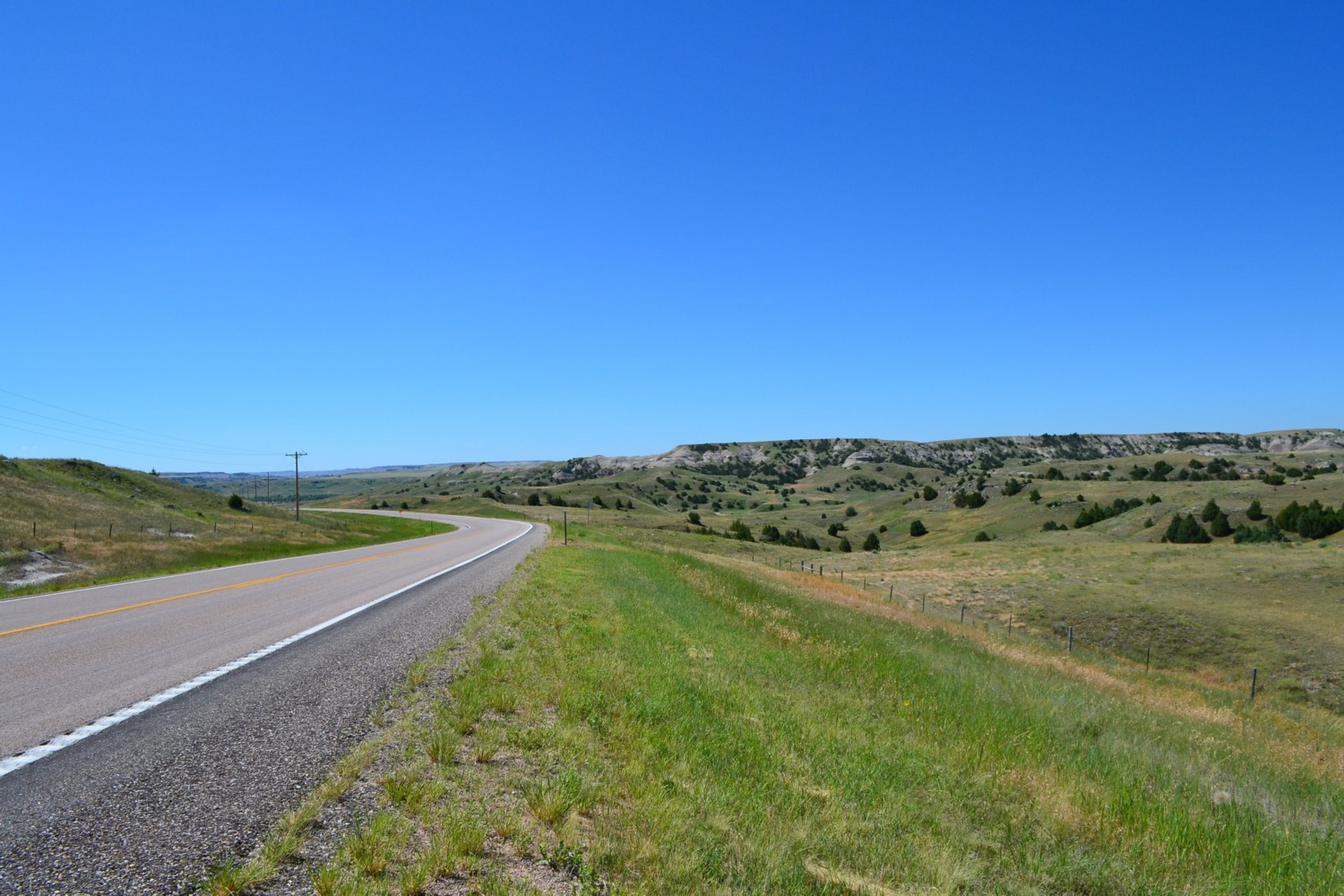
Rt. 40 Heading South Toward the Pine Ride Reservation, SD

Ian Frazier, in the opening paragraph of his book On the Rez (2000), writes: " 'Bleak' is the word attached in many people's minds to the idea of certain Indian reservations, of which the Oglala's reservation is perhaps the best example. Oddly, it is a word I have never heard used by Indians themselves."

This is not surprising, I suppose. For those people not from Pine Ridge, particularly the proverbial white middle class American of mixed European ancestry (like myself who bears traces of Irish, French, German, and Danish bloodlines), Pine Ridge IS bleak. Long dun-colored plains and rolling hills stubbled with clusters of dark green tree growth. Vast swaths of emptiness. Occasional homesteads, often a trailer, surrounded by the debris of poverty - broken pick-up trucks, plastic buckets, piles of rusting machinery, haphazard fencing, clothes lines, scattered boards, masonry, other construction material, leaning sheds. Weary-looking towns like Pine Ridge itself, its main street ornamented by a Shell station and a Subway, piles of sand in the gutters.

The Town of Pine Ridge

While the landscape itself betrays a sort of exquisite wild beauty, the fact that all this formidable emptiness is not some National Wilderness Area but is actually the 'reward' the Lakota got in defeat, the place where they're supposed to make their livelihood, makes "bleak" an appropriate adjective to use in describing it all. And certainly for many of the non-Indian visitors who sees it as bleak, shame no doubt informs that impression.

ND and I drove south from Rapid City on rt. 41, a long straight empty two lane bereft of traffic. Just after Red Shirt we pulled over to see the wares of a Lakota jewelry seller. He sat under a makeshift shelter on a bluff overlooking an expansive gash of Badlands that appeared where the grassy prairie fell away abruptly. We'd no sooner stopped and exchanged friendly greetings with the man when, from the opposite direction that we'd been going, a caravan of cars and vans pulled up in a calm-shattering hubbub of gravel-crunching and dust. The vehicles disgorged a chattering gaggle of doughy white people who proceeded to swarm around the small display of jewelry and then quickly fanned out across the overlook. Most of them gathered on the bluff overlooking the Badlands vista and arranged themselves into a "team" photo.

The suddenness of their arrival was jarring, their gaudy-colored clothes and their chattering shattered the silence, quashing the quiet, almost spiritual reverie that ND and I'd both felt when we'd initially stepped out of our car. They were Christians. Missionaries, actually, from Chattanooga, TN. Disturbing on so many levels. ND and I shrank into the background and watched the missionaries idly handle a necklace, some earrings, and make cursory sales talk with the Lakota man who responded in friendly tones and a kind expression. Eventually, the few shoppers went off to join their picture-snapping cohorts and we approached the jewelry maker again.

Tom the Lakota Artisan (right) with Lescaret
His name was Tom, he lived in Red Shirt and he & his wife made Lakota necklaces & earrings that they sold here at the scenic overlook. Tom spoke in a soft and friendly tone, forthcoming and without a trace of rancor or suspicion. ND and I both were appalled by the Christians and said as much and Tom, without explicitly agreeing with our condemnation, stated that he himself was a full-blooded Lakota and that he lived and believed the Lakota ways. Our conversation was easy and friendly and Tom was more or less unguarded in offering his opinions.

On Leonard Peltier: "He took the fall. He didn't kill those FBI agents, the guy who did admitted it in prison, he was in for something else, but that guy is dead now. Leonard took the fall."

On the Crazy Horse Memorial being carved from a mountain near MT. Rushmore: "They were supposed to build a school for native people and they never did." And, about the profile of Crazy Horse (which is all there is yet): "It looks like George C. Scott."

On the Pine Ridge Reservation: "They took the Black Hills and gave us this ..." (gesturing out across the eroded fissure of Badlands).

On the symbolism of the turtle (used in several of his necklaces): "It means 'woman' because they carry the load on their backs."

On alcohol: "All it gets you is jail or detox, and I've had both."

We bought a few pieces of his work and asked him what a Lakota would say when saying good-bye.

"Dok-sha," he said, "it means 'we may meet again'."


Saturday, June 1, 2013

USSR in Color 1963

A collection of photographs of the USSR in 1963, in color. Photographer unknown. A long line of people waiting to see the embalmed body of Vladimir Lenin. It's hard to think of the USSR in color. Enemies are always black and white.

Red Square, Moscow, 1963, photographer unknown

Friday, May 10, 2013

Atop Mt. Wachusett

Small patches of disgruntled snow still crusted some of the ski slopes but the main road to the summit (repaved last year) was clear. A fine spring day for climbing. Blue sky. Boston and Worcester visible in milky haze. The CIA and weather towers, fenced off, held no real menace. No raptors seen soaring on the thermals. No one else on top, a late Tuesday afternoon.

A Difficult Decision

View from the Summit


Monday, April 29, 2013

Repairing a Stone Wall

An old stone wall runs along the north edge of some 15 acres of woodland I've inherited. I grew up on this land and played on the wall many times and, as an adult, marveled at it periodically when I would return to the homestead and go walking on the land. When my father passed away and the land came to me last year, I began to see it differently. I began to see it as it could be if tastefully managed, if care was given to piling brush and making walking paths.

Before
And as if seeing it for the first time I saw the wall almost as an organic being, something once completely formed but that has since suffered the ravages of decades. In many places, it had crumbled and the stones that had fallen out were buried under years of decayed plant material. Someone had once put enormous energy and vision into the wall's construction; it occurred to me that I could repair it. So I started.

Four hours completely focused, a joy of Zen mindfulness, doing the real work until my fingers (though gloved) were sore from scratching the forest humus to get at the heavy granite and shale stones, and hefting them back into place. I learned that repairing a stone wall teaches you how to build a stone wall. I peered inside the wall, into openings not peered into for a hundred years or more, I cleared away matted detritus several inches thick and meshed with tiny roots, I pushed away the husks of pine cones long ago eaten by grey squirrels. I smelled the forest, listened to birds, and completely forget that I was there.

After

Saturday, April 27, 2013

Big Spring Ride Through Childhood Places

Squannacook River, mile 19
In the end, it was 43.50 miles, over three hours in the saddle, most of the morning and into the afternoon. En bicyclette. Through time and place. Lemonstar to Shirley, home town, past childhood split level ranch house and on up the road then down the road into West Groton and then to the wildlife management area, the Squannacook River swimming hole where I spent many summer afternoons and evenings with Tom and friends and where I hurled into space on a rope swing and dropped into the cool tea colored waters, and where, in high school years, we partied and called the spot "Silky's", I don't know why, now fly fishermen know the banks well and there isn't a piece of garbage to be seen and the big tree with the rope swing has vanished, the bank eroded away by the river's inevitable hunger.

Pepperell, Mass, mile 22
Onward, into Pepperell and a visit with friend TS who hails from Lowell, the nephew of Jack Kerouac, his aunt Kerouac's third wife, TS met the besotted writer genius tragic Boddhisattva fool a couple of times, TS now archival specialist, learned book man, musician, big-handed Greek, generous, gentle, welcoming. And then onward, back roads in the woods, New Englanders on a sunny April morning raking their yards, burning leaves, waving back if I wave, whiz down Heald St. and into the center of Pepperell aka Pepperville, old town blighted by fast food plastic and scruff streets, a river flows through it though they tore down the big brick mill long ago aside the rushing waters.

There's a rail trail in Pepperell, it goes north into New Hampshire and south toward Ayer, I picked it up and headed south, it's a mostly flat trail with gradual inclines south toward Groton and then a gradual declination after that, I huffed it and tried to keep my cadence firm, tried to maintain around 17 m.p.h., occasionally fatigued I dipped the speed to 15 m.p.h or so and occasionally other rail trailers caused me to slow too and I'd call out "passing on your left!" At one point along the eight or so miles that I was covering of the trail I glanced behind me and saw someone oncoming, someone using me as their rabbit so I "dug into my suitcase of courage" (to borrow an inimitable Paul Sherwenism) and picked up the pace to 20 m.p.h. and kept the predator at bay until I bailed off the trail and headed for the road that crosses behind the old Fort Devens airport, I've always called it River Rd but that's not really what it's named, nevertheless it does follow the Nashua River and I enjoy this stretch, many, many years ago my father trapped muskrats along this river and I would often go with him to check the trap line and  I recalled those days as I pedaled with growing fatigue along the pavement (flat) toward Devens, and the Main Gate, across from which the road ended.

Nashua River, mile 31
Devens used to be Fort Devens of course, the largest army base in New England once-upon-a-time, I spent many, many hours on the base, in fact I was BORN on the base (though the hospital has long since been torn down), I'd buy albums at the PX, enjoy summer swims in the outdoor pools, go to the movies at one of the three theaters ("Destroy All Monsters" 1968 was a favorite, "Taxi Driver" 1974 I was too young to see but saw it anyway, "Slap Shot" 1977 we lived for hockey), today the fort is just the town of Devens though there is a Federal prison hospital and the news just came that the scurrilous wretch Dzhokhar Tsarnaev has been transferred there, I rode across Devens anyway (going nowhere near the prison facility) and exited back into Shirley and from there rode on with weary legs past my elementary school (Lura A. White School) and down what we used to call "Tummy Tickle Rd" because of its ups and downs, and then finally atop Rice Hill and Gove Farm from which point you look across one of the very last apple orchards in the city that birthed Johnny Appleseed down into the city of Lemonstar.

Rice Hill and Gove Farm Looking Toward Lemonstar, mile 40
Then three miles or so through the 'hood and back to the home neighborhood and, famished, a focused effort in the kitchen & at the grill and in no time (well, within an hour of getting back), a big grilled ribeye steak from the CSA in Groton, sauteed mushrooms, grilled onions, roasted cauliflower, two glasses of pinot noir from Oregon, two pints of water, and a cup of Russian Caravan tea ... and the ride was duly finalized.

All That's Left


Wednesday, April 17, 2013

One Runner Who Died

Lawrence Academy Cross Country Team 1972
(Tom is 3rd from the right)
I was never a runner, though my brother was - my brother who died in 1979 of a brain tumor, just 22 years old. My brother who never made it out of the 1970s but who ran with grace and grit and elegance and urgency. Some of those who ran with him on those cross country teams at Lawrence Academy in 1973, 1974, and 1975 remain close friends today.

When someone you love dies young and you outlive them by decades, from time to time you pause to consider all the things that came after their brief sojourn here. The good and the bad. Tom never watched Larry Bird play basketball, never read a book by David Foster Wallace, never got to see the Miracle on Ice at the 1980 Winter Olympics at Lake Placid, never saw the Berlin Wall come down. He also never witnessed the September 11 attacks, never anguished over our country's war crimes in Iraq, never fretted and seethed over the Reagan and Bush presidencies.

Tom (center) running cross country
Lawrence Academy, 1974

And he never felt the anguish and anger that we've just experienced at the Boston Marathon on April 15, 2013. 

For me, there is always a part of him that lives on, that runs with great determined strides, his long black hair flying back, sinewy arms pumping. He would have cried with the rest of us this week. And he probably would have started training for next year's Boston Marathon. He wouldn't abide despair. And neither, I think, will Boston itself.